 PolyOMIC Solutions
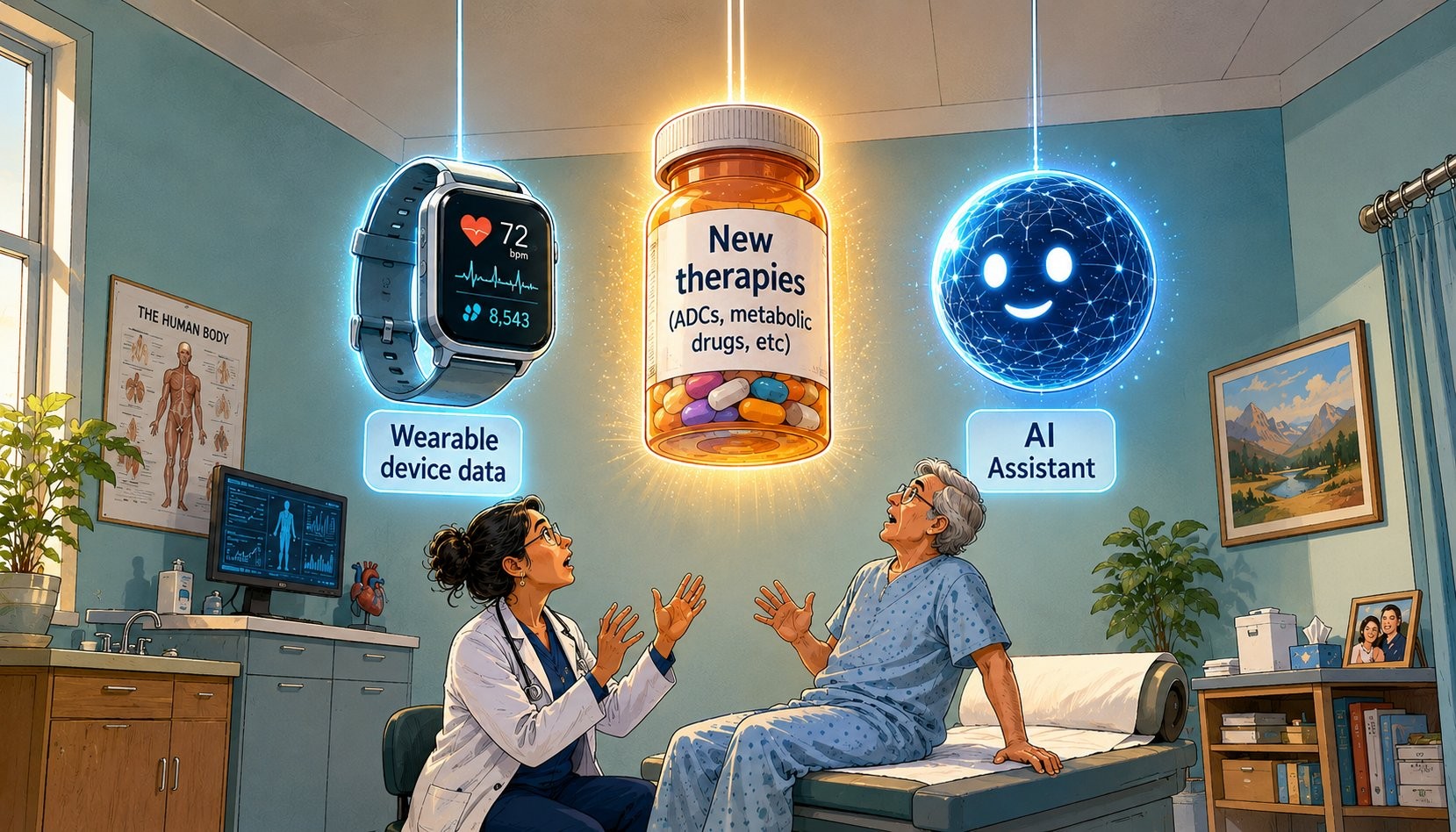
Standards in Motion
Standards of care being contested — oncology, obesity, clinical AI, and wearables.
-
Isomorphic Labs, the DeepMind spinout, raises $2.1B Series B (May 12) — to scale its IsoDDE drug-design engine and push proprietary therapeutic programs toward Phase I. Existing big-pharma partnerships: Eli Lilly, Novartis, Johnson & Johnson.
👉 Why it matters: “AI-native pharma R&D” is being treated as critical infrastructure. Sovereign wealth funds (UAE, Singapore, UK) writing checks alongside Alphabet is the signal — this is the AI drug-design layer being capitalized as a strategic asset, not a venture bet. Bloomberg →
-
Garmin CIRQA expected to launch — another screenless smart band priced around $500 with no subscription requirement (see Whoop and Fitbit Air / Google Health, Issue 5–6).
👉 Why it matters: A growing number of screenless wearables (Whoop, Fitbit Air, Oura, Garmin CIRQA, Polar Loop, Amazfit Helio Strap) employ different business models — subscription-only vs. one-time cost. The hardware is converging while the monetization model is the differentiator. Forbes →
The screenless wearable race — same form, six business models
Device Hardware $ Subscription Model Whoop 5.0 Included $30/mo Subscription-only Fitbit Air $99 Google Health Premium opt-in Hardware + freemium Oura Ring 4 $349+ $6/mo Hardware + low-cost sub Garmin CIRQA ✨ ~$509 None Hardware-only · ecosystem play Polar Loop $180 None Hardware-only Amazfit Helio Strap $100 Free w/ device Budget hardware-only ✨ = launching this week. Six near-identical devices, six different monetization paths.
-
OpenEvidence hands-free Voice Mode lands Cedars-Sinai enterprise deal (May 20) — Cedars-Sinai is the third major health system (after Sutter Health in February and Mount Sinai in March) to deploy Epic-integrated OpenEvidence, the most widely used medical AI and clinical decision-making tool among U.S. physicians. “OpenEvidence acts as an intelligent system that can interpret clinical questions, dynamically gather relevant patient data, evaluate the latest medical literature, and synthesize these inputs into context-aware answers — supporting clinicians with reasoning that reflects both the science and the specific patient.”
👉 Why it matters: This is what “agentic clinical AI at scale” looks like — ~860,000 clinicians on the platform. The point-of-care AI infrastructure layer is no longer theoretical. Press release →
-
CMS Electronic Prior Authorization Acceleration Initiative (May 13) — 29 early adopters, including health systems, EHR vendors, and digital health developers (Cleveland Clinic, Ochsner Health, Epic, Oracle, athenahealth, MEDITECH), joined efforts with five major payers: UnitedHealthcare, Aetna, Cigna, Humana, and Elevance.
👉 Why it matters: Prior authorization is the single most-cited operational friction in U.S. healthcare, costing roughly $50B/year. Having Epic, Oracle, and the four largest payers at the table = a path to a solution before the January 1, 2027 federal deadline. CMS →
-
FDA approves Gilead’s Hepcludex for chronic Hepatitis Delta Virus (HDV) (May 22) — the most severe form of viral hepatitis. This is the first therapy that blocks viral entry into hepatocytes.
👉 Why it matters: This is the 7th accelerated approval granted under the Commissioner’s National Priority Voucher (CNPV) Pilot Program — which dramatically accelerates FDA review timelines for drugs and biologics advancing U.S. national health priorities, like orphan/neglected infectious diseases such as HDV (~80K U.S. cases). FDA →
Two ceilings raised in 24 hours:
-
1. Datroway (datopotamab deruxtecan) approved for 1st-line metastatic TNBC (May 22) — AstraZeneca/Daiichi Sankyo’s TROP2 antibody-drug conjugate becomes the first non-chemo 1st-line option for ~70% of metastatic TNBC patients (those not eligible for PD-1/PD-L1).
👉 Why it matters: TROP2 ADCs join HER2 ADCs (Enhertu, Issue 6) as the second major ADC class to move up the cancer-care timeline in two weeks. Same companies (AZ + Daiichi). Same platform with cytotoxic “warhead” DXd (deruxtecan, topo I inhibitor). Different antigen targets (HER2/ERBB2 vs. TROP2), different indications, same story: the ADC era is operational.
ADC is moving to front line
Same companies, same payload, different antigens. The franchise is the platform.
AstraZeneca + Daiichi Sankyo → Datroway becomes their 2nd ADC approved as a 1st-line treatment ↓ ↓ Enhertu (T-DXd)HER2 / ERBB2 antibody✓ HER2+ early BC (neoadj + adj)May 15, 2026 · Issue 6+ Datroway (Dato-DXd)TROP2 antibody✓ 1L metastatic TNBC (PD-L1 ineligible)May 22, 2026 · Issue 7 -
2. Retatrutide TRIUMPH-1 Phase 3 data (May 21) — Eli Lilly’s triple agonist (GLP-1 + GIP + glucagon) hit primary endpoint with 28.3% mean weight loss at 80 weeks, and 30.3% at 104 weeks in the BMI ≥35 extension cohort.
👉 Why it matters: The obesity drug class just crossed into territory once reserved for bariatric surgery. Retatrutide isn’t “another GLP-1” — the “obesity drug” category is rapidly becoming the cardiometabolic-disease platform category. The Lilly → Omada coaching wrap (Issue 6) suddenly makes more sense: a drug this powerful needs a behavioral OS around it. Lilly →
The obesity drug ceiling — mean weight loss at trial endpoint
Once the threshold required a surgeon. This week, it didn’t.
Wegovy 2.4mg 15%Zepbound 15mg 21%Retatrutide 12mg ✨ 28% (80wk) → 30% (104wk)Bariatric surgery ~30% (reference)✨ = May 21, 2026 Phase 3 readout (TRIUMPH-1). Retatrutide is the first multi-receptor incretin (GLP-1 + GIP + glucagon) to deliver bariatric-equivalent weight loss in a placebo-controlled trial.
Standards in Motion
Four forces converged on the exam room this week — new metabolic drug classes, antibody-drug conjugates, an agentic AI assistant, and continuous wearable signals — each one aimed at displacing something already there.
Four independent stories filed this week under four different beats. They look unrelated. They aren’t. Each raises the same question: whether a longstanding standard of care is about to be substituted by something newer, cheaper, or more continuous.
None of these substitutions is settled. All of them are in motion.
1. Will obesity drugs replace bariatric surgery?
Retatrutide’s 28% weight loss at 80 weeks (30% at two years) crosses the threshold that once required an OR and a surgeon. The Lilly + Omada deal from last week (Issue 6) suddenly looks necessary, not optional: if a drug delivers 80% of what surgery delivers, the strategic value migrates from the procedure to the longitudinal behavioral wrap around it.
2. Will ADCs replace front-line chemo?
Datroway in 1L TNBC and Enhertu in HER2+ early breast cancer — two ADC approvals in two weeks, same companies (AstraZeneca + Daiichi Sankyo), same DXd payload, different antigens. Both moved up the treatment timeline from late-line salvage into curative-intent and front-line use. Every major oncology player now needs a TROP2 / HER2 / B7-H4 ADC strategy — or a license to one.
3. Will agentic AI replace the reference library?
OpenEvidence is now live in Epic at Sutter, Mount Sinai, and Cedars-Sinai — three top-tier academic medical centers, deployed in 90 days, with patient-aware context pulled directly from the EHR and a hands-free voice interface. The question is no longer whether agentic AI works at the point of care, but how the existing clinical reference market (UpToDate, Lexicomp, DynaMed) survives a single tool that consolidates all of them.
4. Will wearables replace episodic measurement?
The wrist is emerging from a fitness category into a source of clinically actionable data. With Fitbit becoming Google Health (Issue 6), Whoop expanding into clinical signals, Oura already FDA-cleared on several indications, and Garmin’s CIRQA launch anticipated this week, real-time physiologic data is converging toward something a physician can act on. CMS ACCESS (Issue 6, launching July 5) is the first federal reimbursement model designed to pay for outcomes built on exactly this data.
Substitution is what acceleration looks like — even when the outcome is uncertain. Four established standards of care were credibly contested this week: bariatric surgery, front-line chemo, separate reference tools, and episodic measurement. None of the substitutions is decided. All of them are in motion at the same time. The strategic question isn’t “which capability wins?” — it’s “which organizations can absorb new capability fast enough to stay competitive while the answers are being written?”
OpenEvidence: How agentic clinical AI is consolidating the medical reference market — Sacra Research. Read the deep dive →
Stay decoded.
Join readers getting the clearest signal in digital health — every Wednesday, free.
No spam. Unsubscribe anytime. Powered by Beehiiv.