PolyOMIC Solutions
Weekly clarity on the trends, breakthroughs, and regulatory shifts shaping digital health — filtered through a translational science lens, so you know what actually matters for your work.
Powered by Beehiiv — no spam, unsubscribe anytime.
Standards of care being contested — oncology, obesity, clinical AI, and wearables.
Isomorphic Labs, the DeepMind spinout, raises $2.1B Series B (May 12) — to scale its IsoDDE drug-design engine and push proprietary therapeutic programs toward Phase I. Existing big-pharma partnerships: Eli Lilly, Novartis, Johnson & Johnson.
👉 Why it matters: “AI-native pharma R&D” is being treated as critical infrastructure. Sovereign wealth funds (UAE, Singapore, UK) writing checks alongside Alphabet is the signal — this is the AI drug-design layer being capitalized as a strategic asset, not a venture bet. Bloomberg →
Garmin CIRQA expected to launch — another screenless smart band priced around $500 with no subscription requirement (see Whoop and Fitbit Air / Google Health, Issue 5–6).
👉 Why it matters: A growing number of screenless wearables (Whoop, Fitbit Air, Oura, Garmin CIRQA, Polar Loop, Amazfit Helio Strap) employ different business models — subscription-only vs. one-time cost. The hardware is converging while the monetization model is the differentiator. Forbes →
OpenEvidence hands-free Voice Mode lands Cedars-Sinai enterprise deal (May 20) — Cedars-Sinai is the third major health system (after Sutter Health in February and Mount Sinai in March) to deploy Epic-integrated OpenEvidence, the most widely used medical AI and clinical decision-making tool among U.S. physicians.
👉 Why it matters: This is what “agentic clinical AI at scale” looks like — ~860,000 clinicians on the platform. The point-of-care AI infrastructure layer is no longer theoretical. Press release →
CMS Electronic Prior Authorization Acceleration Initiative (May 13) — 29 early adopters, including health systems, EHR vendors, and digital health developers (Cleveland Clinic, Ochsner Health, Epic, Oracle, athenahealth, MEDITECH), joined efforts with five major payers: UnitedHealthcare, Aetna, Cigna, Humana, and Elevance.
👉 Why it matters: Prior authorization is the single most-cited operational friction in U.S. healthcare, costing roughly $50B/year. Having Epic, Oracle, and the four largest payers at the table = a path to a solution before the January 1, 2027 federal deadline. CMS →
FDA approves Gilead’s Hepcludex for chronic Hepatitis Delta Virus (HDV) (May 22) — the most severe form of viral hepatitis. This is the first therapy that blocks viral entry into hepatocytes.
👉 Why it matters: This is the 7th accelerated approval granted under the Commissioner’s National Priority Voucher (CNPV) Pilot Program. FDA →
Two ceilings raised in 24 hours:
1. Datroway (datopotamab deruxtecan) approved for 1st-line metastatic TNBC (May 22) — AstraZeneca/Daiichi Sankyo’s TROP2 antibody-drug conjugate becomes the first non-chemo 1st-line option for ~70% of metastatic TNBC patients (those not eligible for PD-1/PD-L1).
👉 Why it matters: TROP2 ADCs join HER2 ADCs (Enhertu, Issue 6) as the second major ADC class to move up the cancer-care timeline in two weeks. Same companies (AZ + Daiichi), same DXd platform, different antigens, same story: the ADC era is operational.
2. Retatrutide TRIUMPH-1 Phase 3 data (May 21) — Eli Lilly’s triple agonist (GLP-1 + GIP + glucagon) hit primary endpoint with 28.3% mean weight loss at 80 weeks, and 30.3% at 104 weeks in the BMI ≥35 extension cohort.
👉 Why it matters: The obesity drug class just crossed into territory once reserved for bariatric surgery. The Lilly → Omada coaching wrap (Issue 6) suddenly makes more sense: a drug this powerful needs a behavioral OS around it. Lilly →
Four forces converged on the exam room this week — new metabolic drug classes, antibody-drug conjugates, an agentic AI assistant, and continuous wearable signals — each one aimed at displacing something already there.
None of these substitutions is settled. All of them are in motion.
Four open questions for the week: 1. Will obesity drugs replace bariatric surgery? · 2. Will ADCs replace front-line chemo? · 3. Will agentic AI replace the reference library? · 4. Will wearables replace episodic measurement?
Substitution is what acceleration looks like — even when the outcome is uncertain. Four established standards of care were credibly contested this week: bariatric surgery, front-line chemo, separate reference tools, and episodic measurement. The strategic question isn’t “which capability wins?” — it’s “which organizations can absorb new capability fast enough to stay competitive while the answers are being written?”
OpenEvidence: How agentic clinical AI is consolidating the medical reference market — Sacra Research. Read the deep dive →
| # | Title | Read | Date |
|---|---|---|---|
| #7 | Standards in Motion Latest | 📄 On this site · Beehiiv → | May 27, 2026 |
| #6 | The Operating System for Human Health | 📄 On this site · Beehiiv → | May 20, 2026 |
| #5 | The New Front Doors | 📄 On this site · Beehiiv → | May 13, 2026 |
| #4 | Platforms, Not Products | 📄 On this site · Beehiiv → | May 6, 2026 |
| #3 | The Rise of “Closed-Loop” Pharma | 📄 On this site · Beehiiv → | Apr 23, 2026 |
| #2 | AI Moves Into Clinical Reality — and Security Becomes the New Battleground | 📄 On this site · Beehiiv → | Apr 16, 2026 |
| #1 | The Wearable Wellness Tech — Medical Device Convergence: What does this mean for your product? | 📄 On this site · Beehiiv → | Apr 9, 2026 |
Join readers getting the clearest signal in digital health — every Wednesday, free.
No spam. Unsubscribe anytime. Powered by Beehiiv.
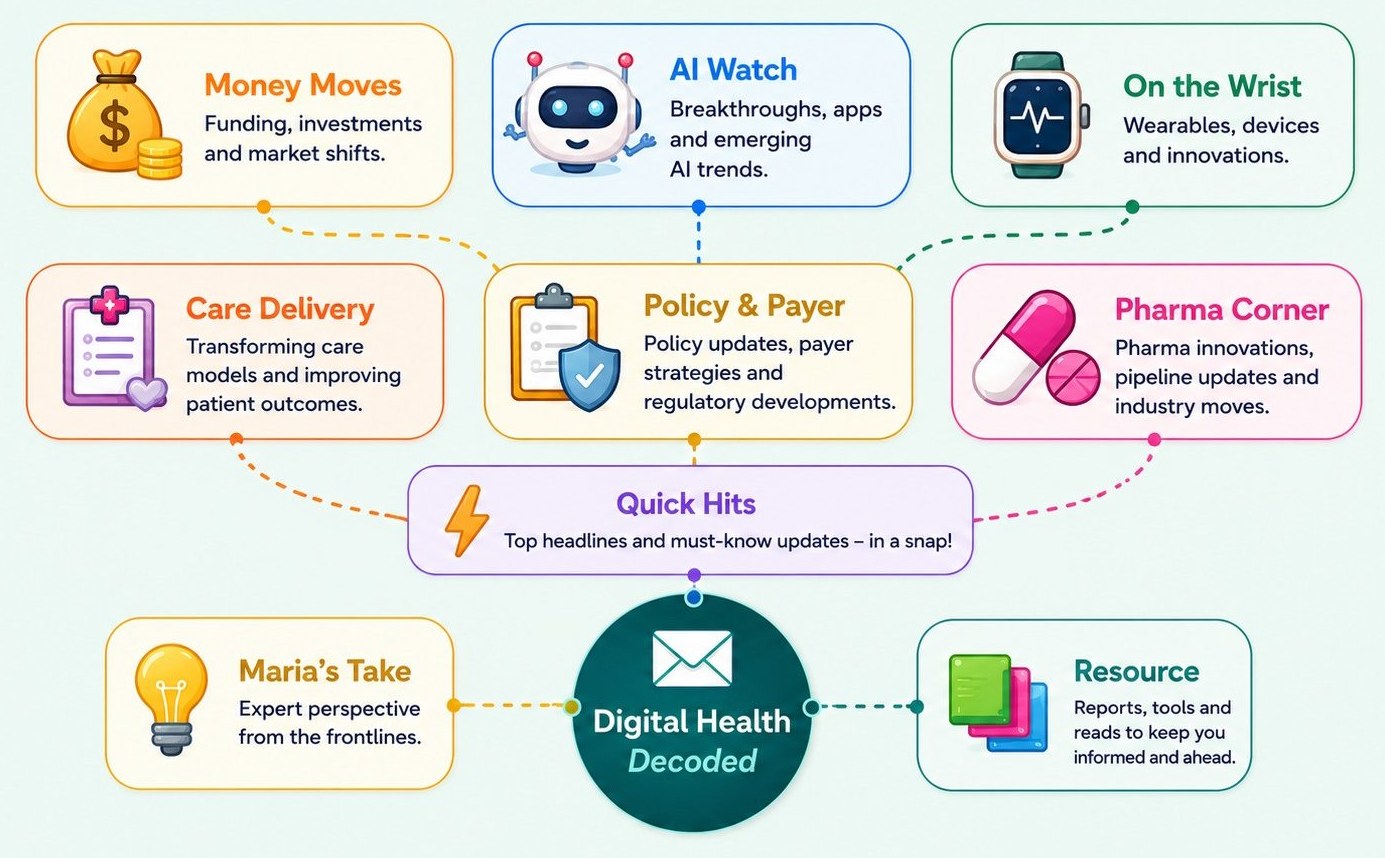
6 categories, 6–10 stories each week — curated from the best sources with Maria’s commentary baked in.
Funding, M&A & valuations
AI & ML in healthcare
Wearables & devices
Hospitals, telehealth & clinical ops
FDA, CMS & reimbursement
Drug development & biotech
A candid, often provocative, expert perspective grounded in decades of translational science and commercialization experience.
A paper, report, or tool that Maria has personally reviewed and recommends — with context on why it matters.